Week 21, 2026
I have spent a large part of my career in that uncomfortable space between speed and structure. I have contributed to products that grew from five to eleven scrum teams, and I have also seen the reverse when things had to be simplified again. Both directions reveal the same underlying truth. What feels like exceptional execution is often something else entirely. It is scarcity. It is lack of constraints. It is proximity. It is a small group of people working intensely, filling in the gaps that systems have not yet defined. In early stages, everything feels efficient. In the early days, everything feels fast. Decisions happen in minutes. Knowledge lives in people’s heads. Leaders often look at this and call it operational excellence. Leadership often looks at this phase and celebrates it as operational excellence. But what I have learned over time is that this feeling of excellence is often an illusion. It is not driven by systems. It is driven by people who are stretching themselves to compensate for the lack of structure. And that illusion becomes dangerous exactly at the moment when the product starts to grow.
In those early stages, adrenaline carries the system. Speed, hustle, and heroics create the feeling of momentum. A few individuals hold the context and connect the dots. Conversations replace process. Memory replaces documentation. People fill in gaps without even being asked. This is why it feels like there is momentum and efficiency at the same time. It works because the team is small enough to rely on direct communication and shared understanding. It also works because early success often depends on behaviours that are not scalable. There is manual effort, its a constant work with hardly any context switching and outcome is positive. But what we often miss is that what feels like great execution is usually just people compensating for missing structure. The system itself is not strong. Things are moving as there is lack of constraints. It is fragile and unstructured, and it only holds because the surface area is still limited. The moment you start scaling, that invisible fragility becomes visible.
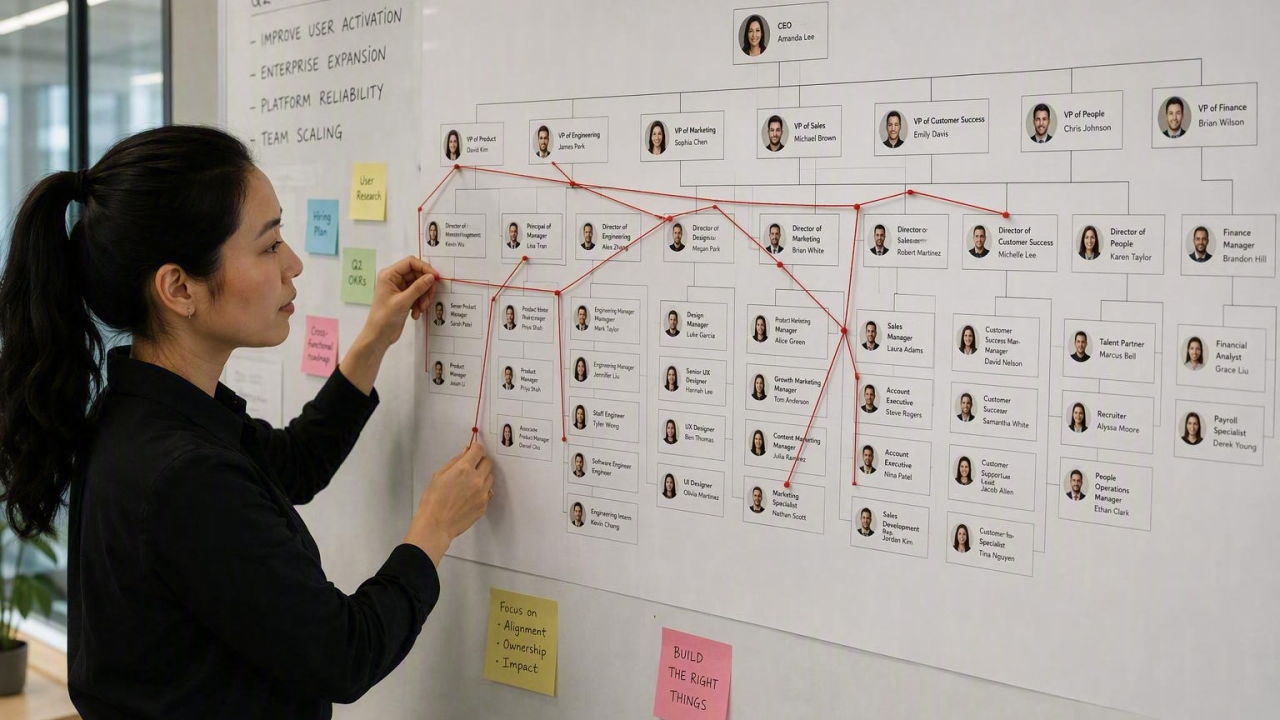
As the product grows, the number of constraints increases and the cracks appear quickly and often unexpectedly. A team of ten can operate informally and still stay aligned. At fifty people, things start to slow down and misalignment shows up in subtle ways. At two hundred, the same patterns lead to chaos. The number of constraints and complexity grow much faster than the coordination models we rely on. Informal communication breaks down because not everyone talks to everyone anymore. Knowledge becomes fragmented across teams. Dependencies on specific individuals turn into bottlenecks that delay decisions and reduce clarity. What makes this transition even harder is that organizations often respond in the wrong way. They try to recreate the feeling of early speed by increasing urgency, pushing for faster responses, and relying on even more intensity. But this is where we need to challenge the narrative. Urgency is not maturity. Responsiveness is not architecture. Intensity is not operational design. These statements sound simple, but they separate the feeling of progress from actual capability. They force us to recognize that what worked in a small team was never designed to work at scale.
At the root of this problem is a simple but uncomfortable dynamic. Early on, humans absorb the chaos. People connect decisions, share context, and resolve ambiguity without needing formal systems. Over time, as the product and organization grow, the number of constraints and complexity increases, and the chaos scales faster than the people can handle. What we often label as technical debt is not only about code. It is organizational ambiguity encoded into the system itself. It shows up in unclear ownership, inconsistent data definitions, overlapping responsibilities, and blurred product boundaries. These are not just process issues. They are design problems. And they compound over time. The real test for any product organization is not whether it can move fast when everything is known and controlled. The real test is whether it can stay coherent when knowledge is distributed, when dependencies increase, and when uncertainty becomes the norm. That is where strong, scalable design reveals itself, and where most organizations struggle if they continue to rely on hero driven execution.
This is exactly where product managers need to step in and challenge both teams and leadership. The goal is not to introduce heavy processes or slow things down with bureaucracy. The goal is to move from ad hoc execution to intentional architecture. That starts with defining clear ownership so decisions do not depend on specific individuals. It requires building clean and repeatable workflows that teams can follow without relying on memory or informal coordination. It demands consistent definitions and trusted data so that alignment does not require constant interpretation. It means establishing strong product and technical boundaries so that teams can operate independently without creating hidden dependencies. And most importantly, it means designing systems that can function even when the original context holders are no longer involved. When we make this shift from hero driven speed to system driven scalability, we do not lose momentum. We make it sustainable. That is the real responsibility of product management in the growth stage. Not just to deliver fast, but to ensure that what we build can keep working as the world around it becomes more complex.
DISCLAIMER: This post reflects my personal views and experiences as a product manager. It does not represent the views, strategies, or opinions of my employer or any organization I am affiliated with.